
Aidan Milliff
The Ohio State University
Assistant Professor of Political Science
Partisanship, Region, and Variation in Indian Public Opinion
This post accompanies Indian Public Opinion Toward the Major Powers, a new book from Paul Staniland and me, published as part of the Cambridge Elements in Indo-Pacific Security series.
The book is free to download from Cambridge Core until 15 June. Thanks Cambridge UP!
This week, Paul Staniland and I appeared on the Grand Tamasha podcast to discuss our new Cambridge University Press Element: Indian Public Opinion Toward the Major Powers. I am always happy to hawk my work—and I’m especially excited about this book, which is the product of nearly a decade of work—but it is a special treat to do so on a show that I listen to regularly. You can check out the episode here:1
For those unfamiliar, Grand Tamasha is a fantastic Indian politics podcast hosted by Milan Vaishnav, a political scientist and director of the South Asia Program at the Carnegie Endowment for International Peace. It is one of the preeminent podcasts about Indian politics, similar to Amit Verma’s The Seen and the Unseen. While I love Amit’s sprawling interviews (like this 4 hour conversation with the brilliant development economist Biju Rao), Grand Tamasha has the advantage of episodes that don’t take a half-day to digest.2
I’m writing this post to deal, in a little more detail, with one of the puzzles we uncover in the book, which Milan asked about on the show. Our analysis of India shows that there are major, durable regional differences in public opinion about foreign policy. Why?
Missing Partisan Politics
Academic literature on foreign policy attitudes pays a lot of attention to partisanship. Foreign policy is, by definition, usually quite remote from people’s everyday experiences, so research has found they often take cues from others (maybe political and media elites, maybe people’s social alters) to form their opinions on foreign policy topics.
We find surprisingly little evidence of partisan cleavages (and thus partisan cue-taking) in India, which is in some senses the place you would most expect to see it. Conventional wisdom holds that the ordinary voter in India has other things on their plate, and doesn’t pay much attention to foreign policy. In a country where food security is not a given, youth unemployment is high even for the highly-educated, and many struggle to afford basic necessities, this is not a wild assumption. India’s juggernaut social science survey, the Lokniti-CSDS National Election Studies barely even ask about foreign policy opinions, as a result.
This is a pretty perfect environment for what scholars of American politics call the Receive–Accept–Sample model of opinion formation. Holding a consistent opinion on political issues requires a pretty high degree of political awareness, and realistically speaking, more attention than most people pay to any given political issue. So when a pollster comes calling to ask about economic policy (the R-A-S model is from 1992 when people answered the phone), people aren’t reporting a consistently held belief about, say, the appropriate top marginal tax rate. Instead, their response reflects the content of relevant messages that they have received (often from elites), accepted as compatible with their pre-existing beliefs, and then sampled i.e. recalled and picked up as relevant to the question they are answering. This whole model implies that public opinion on complex policy areas that are relatively remote from daily life is downstream of partisan politics, which is a normative bummer.
Partisanship, though, doesn’t seem to matter too much in driving Indians’ opinions about foreign countries. In the book, the differences in individual attitudes toward China, Russia, and the U.S. that we can attribute to partisan identity are pretty small and often we cannot reject the null hypothesis that supporters of different parties have on average the same opinion about foreign countries.
This is a weird finding! Foreign policy attitudes in other democracies break down along partisan lines all the time, and sometimes in ways that make it impossible to believe that people are doing anything other than rooting for their team. Democrats and Republicans in the United States, for instance, had relatively similar opinions about the North American Free Trade Agreement (NAFTA) from the 1990s through the 2000s. After then-candidate Donald Trump started to criticize NAFTA as a bad deal, Republican support fell to 22% and Democratic support rose to a highest-ever 67%. In India? Very little. There is scant evidence that supporters of the ruling BJP have more positive attitudes toward China when the BJP is in power, but even this partisan difference is seriously overshadowed. BJP supporters (and other Indians) are less and less likely to express favorable attitudes about China through the 2010s, even as the insanely popular BJP Prime Minister Narendra Modi was pushing for a better relationship with China.
Partisanship could be a bigger factor in Indian foreign policy attitudes in the future. Milan has written about signs that the major political parties are trying to bring foreign policy into electoral campaigns, and he has a great article in the American Journal of Political Science about an instance where the foreign policy and politics mix really backfired for the BJP, which lost voteshare in constituencies that had more exposure to a 2019 terrorist attack.
As of now, however, partisan cuing isn’t a particularly important way that Indians form their foreign policy opinions.
Regional Cleavages in Attitudes toward Foreign Powers
Even weirder than “missing” partisanship: By far the most important correlate of Indian survey respondents’ attitudes toward China, Russia, and the United States is the region of the country where the respondent lives.
Going back to Cold War-era data from the U.S. Information Agency-funded International Images polls (I talk a lot about these on the podcast), region of residence is a strong and durable predictor of Indians’ attitudes toward all three major powers. For example: People in Northern India (the Hindi-speaking part of the country) on average have less positive feelings toward China than people in the South, or the East (toward the Bay of Bengal). These patterns start to appear in the 1970s, and we can see them as late as the 2010s.
India is massive and diverse. Its different states and regions have very distinct political dynamics, and have followed distinct economic and human development trajectories in the 75 years since independence. These differences are not what’s driving the regional cleavages we find. Accounting for cross-regional differences in wealth, education, gender and religious demography, and even partisanship does not “get rid” of the regional differences.
Subnational region is not something that really comes up in political scientist’s research on foreign policy opinions. The only time I had ever given regional perspectives on foreign policy serious thought before starting this project was in a really cool college history class with Bruce Cumings, who had just published a book subtitled “Pacific Ascendancy and American Power.”
Literature on foreign policy attitudes (in the few, predominantly wealthy countries where political scientists tend to study them) do not really find much difference in attitude that they can attribute to “Pacific” vs. “Atlantic” Americans, never mind Israelis in the Negev vs. the Mediterranean cities 90 minutes drive away. In the U.S., foreign policy is all very far away. Otto von Bismarck observed, cheekily, that our neighbors to the North and the South are weak, whereas to the East and the West they are fish. We wouldn’t really expect geography to predict differences in attitudes except among very specific people, like those who live in the highly securitized zone around the U.S.-Mexico border.
Because our book focuses on India, we don’t know if this regional phenomenon is reflected in other countries as well. It might be! To our knowledge, no one has really bothered looking.
We also don’t know exactly how to explain it. As I said on the podcast, I remain a little stumped by the finding and I hope someone (perhaps someone reading this) will figure out the answer.
Why Would Region Matter?
Unlike the U.S., where the dangers and opportunities feel equally far away from everyone,3 different parts of India really do have differential exposure to foreign powers like China. As we discuss in the book, India and China have multiple long-running border disputes in very austere environments in the Himalayas that have become “hot” conflicts in multiple brief crises since the disastrous-for-India 1962 border war. For residents of the Eastern and Northern megacities Kolkata and Delhi, these are neighborhood issues—both are about as close to a disputed border with Pakistan or China as San Francisco is to Los Angeles. If you live in Chennai, however, you’re about as close to the nearest border dispute as New York City is to Miami.
For quite a while, physical proximity to threat was my favorite theory. As the project shifted from a focus on China to a broader field of view, however, it looked less useful. There are significant regional differences in attitudes about Russia, for instance, and Russia has never really been a “threat” that Indians in different regions are more or less exposed to.
Another possibility is that different regional histories of communism explain the regional variation. Good bar trivia fact: India is one of the only places where communist parties have come to power in democratic elections (at the state level in Kerala and West Bengal), and then peacefully left power after losing subsequent elections. The popularity of communist parties in the South and East could explain warmer attitudes toward both China and Russia in the 20th Century. International solidarity is not a perfect explanation though. Russia famously became not communist in the 1990s, and still enjoys higher favorability in South and East India in certain surveys.
A final possibility—probably the one most ripe for further investigation—is that regional differences in foreign policy attitudes reflect regional differences in culture and attachment to national identity. Indians, especially in the South and East, have strong regional or sub-national identities. Many people, according to data from Prerna Singh, prioritize sub-national identity over identity as an “Indian.” If you take this idea seriously, and allow that the meaning and importance of national identity is different between Tamil Nadu and Delhi, you can start to see why people from different regions might think about foreign policy differently. What does India’s competition with China mean, for instance, if you primarily think of yourself as Tamil rather than Indian? You might just take it less personally.
One of the really important ways that Indian regional identity gets reinforced is through language. Hindi, which is the native language of most of Northern India and one of India’s official government languages alongside English, is not widely spoken in Southern states like Kerala, Karnataka, Tamil Nadu and Andhra Pradesh. Even as Hindi’s popularity has “exploded” in the South according to analysis from Scroll.in, the prevalence of Hindi-first speakers in southern states has only soared as high as 3%-4%.
I raise this because it could mean that “cuing” is actually a good explanation for regional variation. This is a hunch, not something we test in our book. Southern and Eastern India have their own movie industries—Bollywood is Hindi-medium, but as of the 2020s, movies in the southern languages of Telegu and Tamil generated larger combined box office revenues—newspapers, TV channels, etc. This might mean, to return to the Receive–Accept–Sample model I mentioned above, that Indians in different regions receive different relevant cues about major foreign policy issues by virtue of consuming news and entertainment in different languages. It would be a little funny if the answer was elite cuing all along, given our discussion of partisanship, but I think it is definitely something worth looking into.
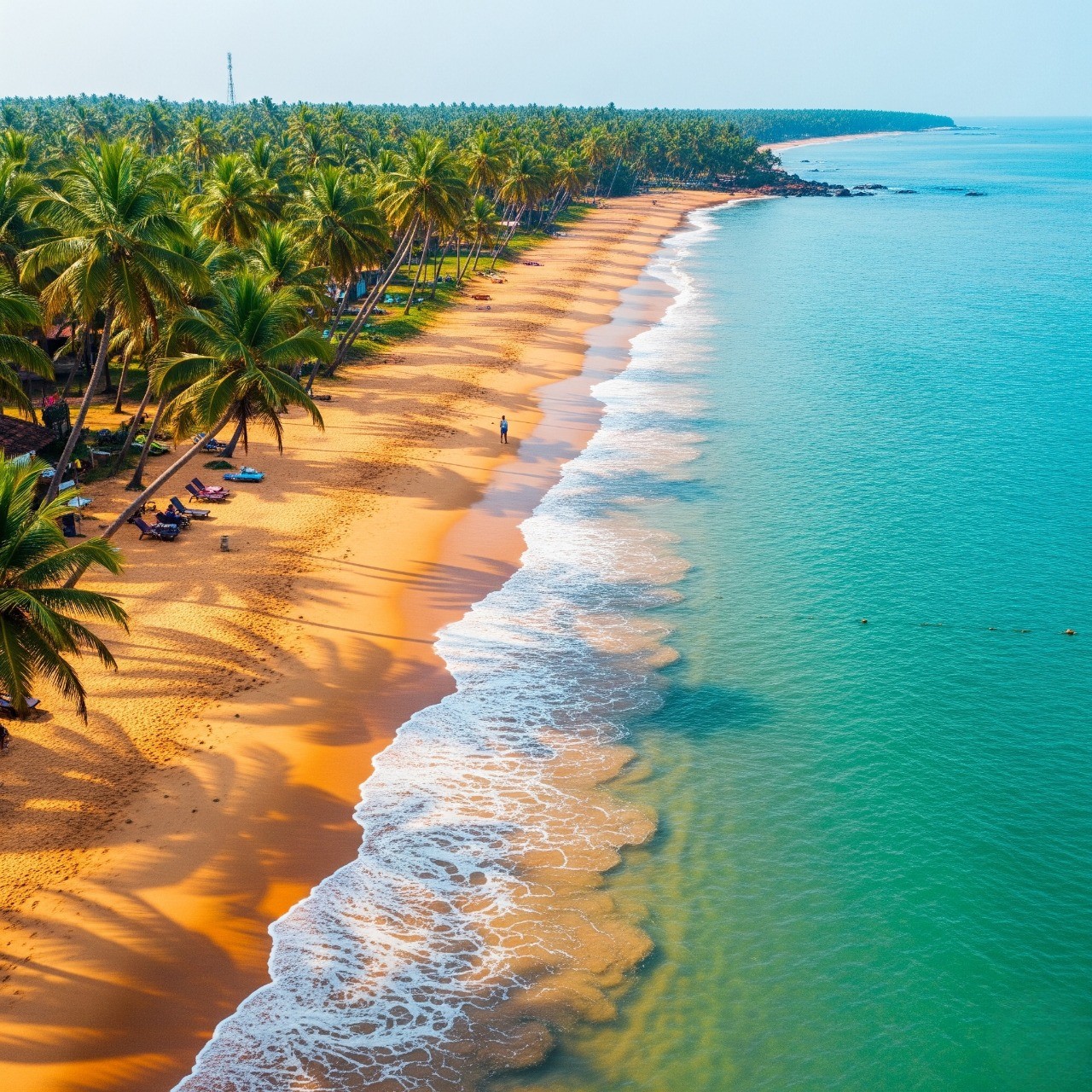
I should close with one less serious possibility. We’ve joked that Indians in the south might just be more positive about everything—China and Russia, sure, but also life satisfaction, the state of the weather, etc. Before you write my idea off as silly, keep in mind that Kerala, on the Southern tip of India, looks like this:
Stray Links
Paul has written more about our public opinion project on his own website, tackling some of the themes that come up in our Element. Check out his posts:
- The Indian “Foreign Policy Public” (who responds to surveys?)
- New Book Out (introducing the project)
We have also shared an index that Paul and RAs created, listing every foreign policy-related question asked in the Indian Institute of Public Opinion polls during the Cold War. We hope others will use it as a finding aid to explore this amazing trove of data. The question index, plus some code useful for cleaning up the punchcard-format data available from the Roper Center are in a GitHub repo:
And once more, here is the book and the podcast:
Milliff, Aidan and Paul Staniland. 2026. Indian Public Opinion Toward the Major Powers. Cambridge Elements in Indo-Pacific Security. Cambridge: Cambridge University Press.
Vaishnav, Milan, host. 2026. “What do Indians Think about the World?” Grand Tamasha Season 15, Episode 21, Carnegie Endowment for International Peace & The Hindustan Times.
Footnotes
Any sound quality deficiencies are my fault. The Carnegie podcast team are pros, but I gave them garbage to work with because I was recording with AirPods from hotel wifi.↩︎
I must disclose my bias here: I worked as Milan’s research assistant before I started graduate school and he is without question the best boss I have ever had.↩︎
Sorry, Sarah Palin.↩︎